
Eden Prairie City Directory Collection Gaps
Hennepin County Library is the main historical directory desk for Eden Prairie research. Its City Directory Collection offers digitized name and address searching, and the broader Hennepin browse gives the strongest regional shelf. The key local finding is negative but useful: no dedicated Eden Prairie digital city-directory run appeared in the official browse. That is a collection limit, not evidence that Eden Prairie lacked residents, businesses, or paper records. Check print shelves, the Historical Society, newspapers, maps, and a targeted Minnesota Historical Society request when a direct local volume is absent.
| Collection or run | Years shown | Where held | How it helps |
|---|---|---|---|
| Eden Prairie-specific digital run | Not located | Official Hennepin digital browse | State the gap, then use a precise library or archive inquiry. |
| Edina directories | 1941-1977 | Hennepin Library digital collection | Nearby-move context, not proof of Eden Prairie residence. |
| Hopkins directories | 1942-1977 | Hennepin Library digital collection | Nearby household and business entries. |
| St. Louis Park directories | 1933-1977 | Hennepin Library digital collection | Long suburban name and address sequence. |
| Minneapolis directories | 1859-1963 in the browse | Hennepin digital and print holdings | Longer regional sequence and reverse-address context. |
The library catalog and browse identify places and years, but they do not establish one publisher for every volume. Read the title page before naming a publisher. Public items in Hennepin Digital Collections may be viewed, printed, and downloaded; Minneapolis Central also has important print shelves. The collection is best treated as a regional evidence shelf, not a single citywide residents list.
Note: A nearby-city directory result should retain its own locality and publication date when added to an Eden Prairie family timeline.
Hennepin Directory Shelves for Eden Prairie
The Hennepin Library genealogy and local-history service combines city directories with census, court, church, military, newspaper, map, photograph, and vital-record research. That broad mix matters when a directory does not list the person or year needed. Special Collections can be reached at specialcoll@hclib.org or 612-543-8200. Start with a surname, an address, an approximate year, and the question being tested, such as whether a household was in a nearby municipality before a later Eden Prairie record.
The Hennepin digital-directory browse displays the regional runs that make this work possible.
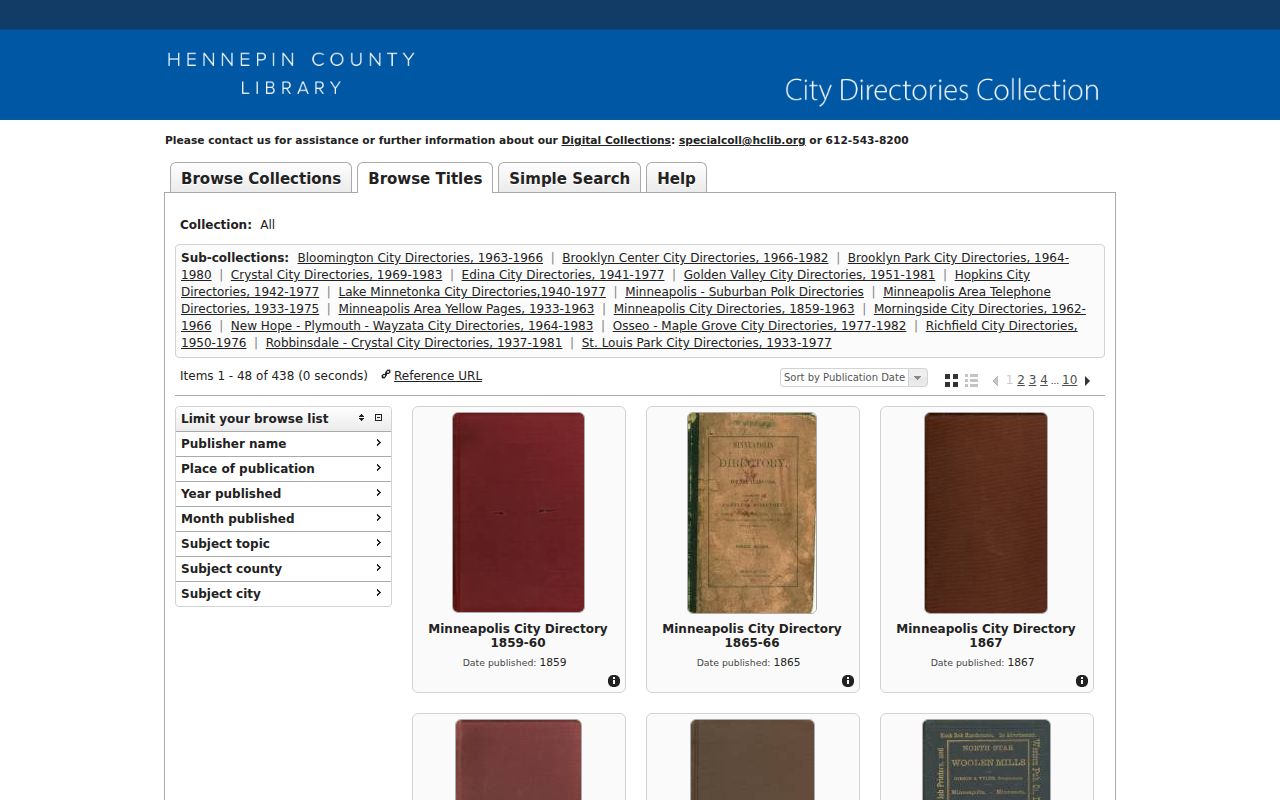
Search the selected locality rather than all cities at once. That keeps a Minneapolis or Edina hit from being mistaken for an Eden Prairie entry. The browse interface reported many local collections, so the right volume and page image matter as much as the typed result.
The library genealogy page is the practical starting point for requesting help with directories, maps, and related historical materials.
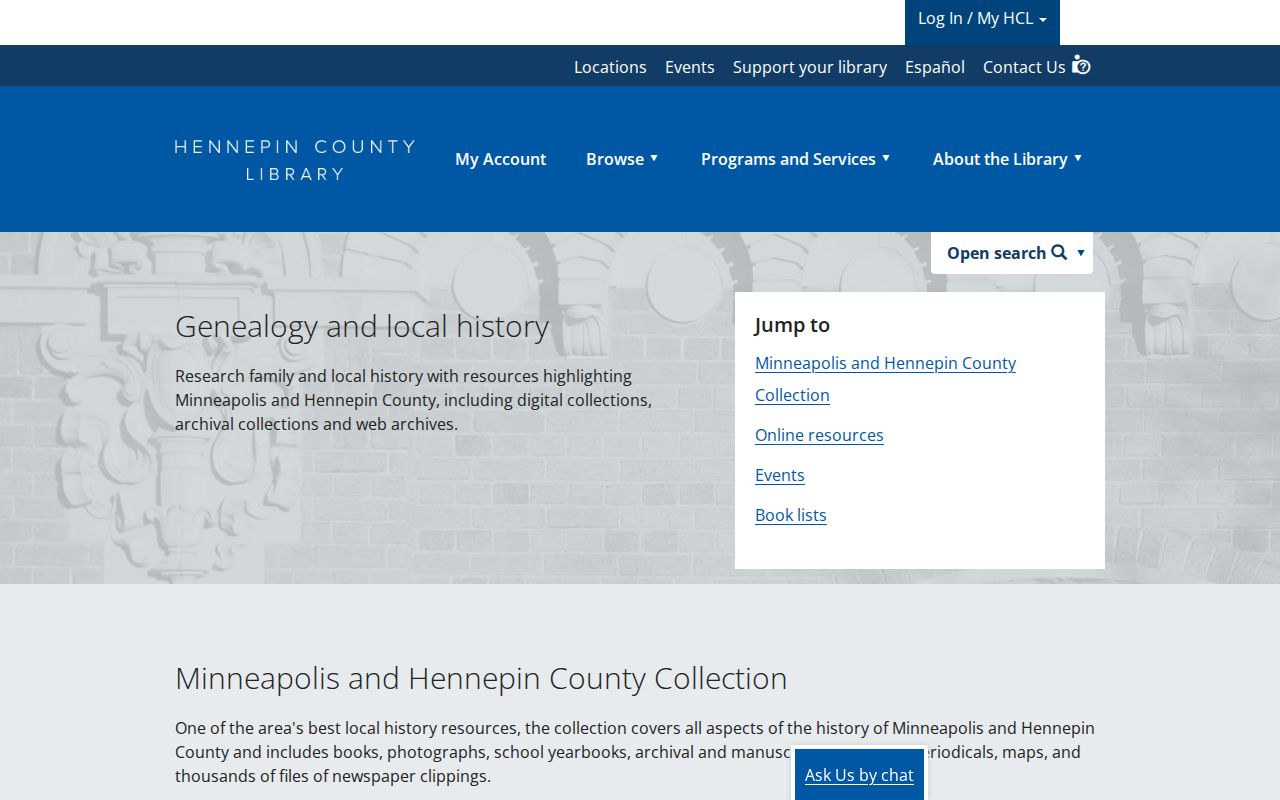
Library support is especially useful where the online collection stops. Ask for a public collection, a print shelf, or an archival citation, rather than assuming the library keeps a current list of local households.
Reading an Eden Prairie City Directory Entry
Hennepin Library's directory tips use a Minneapolis example, so its fields should be read as a guide to historical directory practice, not as an Eden Prairie sample. Entries commonly place the surname first and may shorten given names. A spouse can appear in parentheses, while women may have independent entries in some years. The printed address and occupation are dated clues. More than one result at an address can reflect several people or businesses, so a page image deserves inspection before a household conclusion is made.
| Name form | Surname first, with given-name abbreviations such as Wm. or Chas. possible. |
|---|---|
| Spouse notation | A parenthetical spouse name may appear, but practices vary by year. |
| Address | Street number and street name, sometimes with several entries at one address. |
| Occupation or subject | A printed occupation, affiliation, or separately indexed business subject when the volume supplies it. |
| Resident marker | A dated abbreviation whose meaning must be checked in that volume's key. |
- Criss-cross directory
- An address-first section that reverses a normal name lookup and can show entries associated with one street number.
- Householder index
- An index organized around the named household head or address, depending on the volume.
- Abbreviation key
- The volume's own explanation of short forms and status marks. Photograph or save it with the entry.
Exact searches are case-insensitive in the online collection. An asterisk can match multiple characters and a question mark one character, but neither wildcard starts a search. Search an exact spelling and a careful variant, then inspect surrounding entries for repeated surnames and ditto marks.
Eden Prairie Directory Abbreviation Clues
Historical marks are a small but important trap. In early Minneapolis books, r can mean resident and b boarder. In later volumes, r can instead mean roomer or renter, while h may identify a homeowner or householder. Street shorthand also shifts by volume: Av, Mtka., W Bway, and Lk. are examples from the library guide. Expanding each term into modern spelling can hide the very entry being sought.
Read the printed key in every book. A marker is evidence about how that editor indexed an entry on that publication date, not a permanent statement about a person, family, or property.
Note: Directory abbreviations are year-specific, so save both the entry image and the key that defines its marks.
Tracing Eden Prairie Directory Households
A usable household trail moves one dated observation at a time. Record the exact name form, any spouse notation, the address, occupation, and marker from the first relevant nearby-city or regional volume. Then search the same name and address in adjacent available years. This allows a move, a spelling shift, or a change from an independent entry to a spouse notation to be seen rather than guessed. Census releases provide a separate ten-year snapshot through 1950 under the National Archives 72-year rule.
- Find the first promising entry and save its locality, year, page image, and abbreviation key.
- Search the name and address in adjacent available directory years, including spelling and surname variants.
- Use an address or criss-cross search to identify every entry at that number for that publication date.
- Pair the nearest directory years with the available federal census snapshot and a relevant map or plat.
- Use newspapers, cemetery material, probate, or a vital index to test why the trail ends or changes.
A disappearance can mean a move, death, changed indexing practice, or simple omission. The documented alternatives are Minnesota Historical Society People Records, newspapers, cemetery records, probate files, and the appropriate custodian. For current address-keyed evidence, use the modern records on the Eden Prairie street directory rather than stretching a historical entry beyond its date.
Eden Prairie Directory Maps and Newspapers
Directories gain context when paired with the Hennepin Library house-history guide. It points researchers toward address searching, plat books, maps, directories, newspapers, recorder records, and Sanborn material. Hennepin's maps collection includes atlases from 1873, 1898, 1913, and 1914, plus plats and survey maps. Those sources can translate a rural or township description into a later subdivision, but the specific page must be checked before assigning a name to an Eden Prairie parcel.
Newspaper research supplies another dated layer. The Minnesota Digital Newspaper Hub has material from 1849 to the present, although later material can have access restrictions. Hennepin Library also describes in-library Star Tribune access from 1867 onward. Neither source is a complete obituary index for Eden Prairie, and no comprehensive standalone Eden Prairie obituary index was located in the library material.
Eden Prairie Historical Society Context
Eden Prairie's local history adds a useful layer when a regional volume falls short. The city places the first town-board meeting in a log schoolhouse on May 11, 1858, and later growth shifted the record trail from township maps toward more modern parcel and municipal systems. The Eden Prairie Historical Society, an independent volunteer-run museum in City Center, links oral histories, heritage-map material, and historic images. It is a research contact, not an all-resident index.
The Historical Society's public page is a good place to confirm the local contact route before making a focused inquiry.
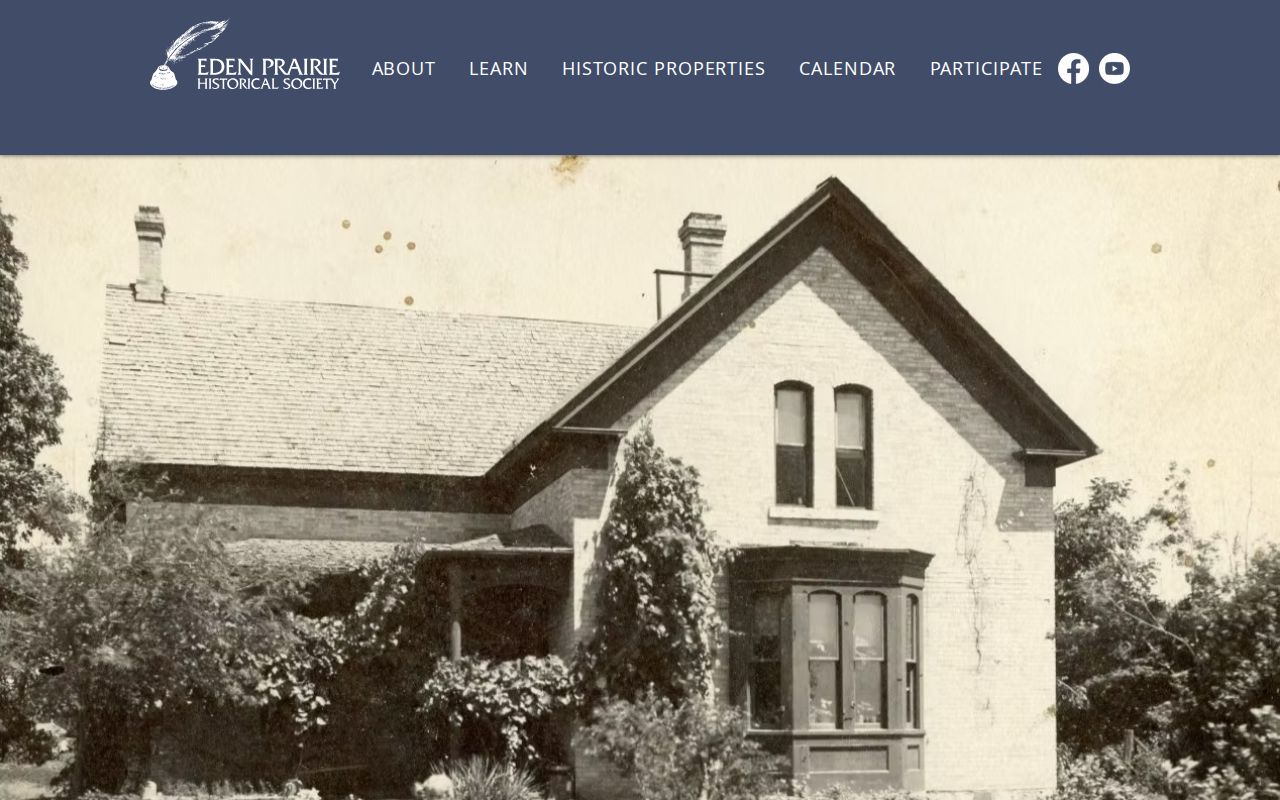
Give the society a surname, address, approximate year, and record type. Oral histories or heritage-site material may explain a name or location, but should be paired with a dated directory, map, deed, or city record for a documented residence claim.
Eden Prairie City Directory Research Limits
Three limits keep this work accurate. No dedicated Eden Prairie digital run was located in the official Hennepin browse. No single publisher can be assigned to every nearby volume without inspecting its title page. Finally, a directory generally records an entry for a publication date, not every household member or a lasting address. These limits do not end a search. They set the next move: print shelves, an MNHS staff search, maps, a newspaper, a city request, or the Historical Society.
MNHS offers a targeted directory and telephone-book search for one person or business across up to five years when holdings permit. The research notes list $20 for both directory and telephone-book searching plus a $5 nonrefundable processing component, with usual completion in three to four weeks and up to twelve weeks. Availability varies by city and year, so the request should name the location and date range precisely.
The request can be for city directories, telephone books, or both, with digital delivery included when the service finds material. Its own cautions are part of the result: not every city or year exists, directories often list heads of household, and minors may not appear. That makes a negative staff search useful evidence about the holdings searched, not a final answer about an Eden Prairie family.
Note: Keep the source locality, publication year, page image, and the reason each record supports a family-history conclusion.